
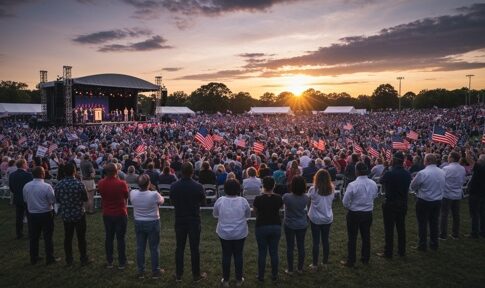
On the very day America marked 250 years of independence, a crushing heat wave shut down parades and fairs that were supposed to celebrate that freedom.
Story Snapshot
- Record-breaking heat forced major America 250 events in Philadelphia and Washington, D.C. to cancel or delay.
- Millions across the East Coast spent the holiday under dangerous heat alerts with “feels like” readings above 110 degrees.
- Local officials and the Trump White House said safety came first, but poor planning and secrecy are raising questions.
- The disruptions highlight a deeper problem both left and right see: leaders react late while ordinary Americans absorb the risk.
Historic heat wave collides with America 250 celebrations
Across the central and eastern United States, a powerful heat dome pushed temperatures into triple digits as Americans gathered for the 250th birthday of the country. The National Weather Service said more than half the nation, over 185 million people, were under some kind of heat alert as heat index values in some areas were expected to reach up to 115 degrees. This was not a summer inconvenience. It was a direct hit on events planned for years as a once-in-a-generation national celebration.
Philadelphia, often called the birthplace of American liberty, became an early symbol of how serious the situation was. Officials there canceled the Salute to Independence Semiquincentennial Parade, a marquee event of the Wawa Welcome America festival, specifically citing “extreme heat.” Local reports noted temperatures near 103 degrees, tying records from the early 1900s. Nearby towns across Pennsylvania and New Jersey also dropped their July 4 parades as dangerous heat and humidity made long outdoor events too risky for families and older residents.
Washington events delayed, fairs closed, and people fall ill
In Washington, D.C., the impact was just as visible but somewhat more complicated. The Great American State Fair on the National Mall, a centerpiece of President Donald Trump’s “Freedom 250” branding of the anniversary, was forced to shut down for several afternoon hours after temperatures hit around 101 degrees. Organizers said the fair would reopen at 5 p.m. local time, once conditions improved, essentially admitting that the mid-day schedule put people into the teeth of the worst heat.
Other capital events were reshaped instead of canceled outright. The long-planned “Salute to America” program had its start time pushed from early afternoon into the cooler evening hours due to the forecast of triple-digit heat indices, and entry for the popular “A Capitol Fourth” concert on the West Lawn of the Capitol was delayed by several hours as a safety measure. At the same time, emergency medical teams treated people for heat-related illness at 250th anniversary events, and national health data showed a sharp rise in emergency room visits for heat stroke across affected states. For those standing on hot pavement behind security fences, it felt less like a festival and more like a stress test of the system.
Official safety message meets planning failures and secrecy
From the White House podium, the message was clear and simple: President Trump’s top priority was the “safety and security” of those attending Freedom 250 events. That line will ring true for many readers who see weather like this and think of elderly parents, kids, and veterans in crowded spaces. But inside the government, some officials questioned why key events were set for the hottest hours of the day in the first place, suggesting better planning might have avoided last-minute chaos. That gap between talking points and preparation feeds a growing distrust on both left and right.
Institutional silence is not helping. The Office of the Attending Physician and United States Capitol Police have not released the specific safety consultations that led to rehearsal changes and partial closures. Without those details, citizens are asked to simply trust that the same institutions that often miss warning signs suddenly got everything right behind closed doors. For conservatives who worry about unaccountable “deep state” experts, and for liberals who fear agencies shield powerful interests, this secrecy feels familiar. It looks like another situation where decision makers dodge full transparency while ordinary people cope with the fallout.
Cooling centers, canceled parades, and a system on its heels
City officials across the region scrambled to soften the blow as the heat pushed systems to their limits. New York City opened extra cooling centers, including large public venues, and kept them available through the holiday weekend so residents without air conditioning had somewhere safe to go. Philadelphia authorities rolled out their own extreme heat guidance, warning that such events are becoming more common as the climate warms and explaining how older residents, people with health problems, and those living in dense, paved neighborhoods face the highest risk. These steps helped, but they also revealed how fragile day-to-day life becomes when the weather turns against us.
Happy 4th of July, Maryland! We hope that you all are safely celebrating 250 years of the United States of America!
Remember to celebrate safely and responsibly, especially during this heat wave: pic.twitter.com/m9PYbA7Pkd
— Maryland Department of Emergency Management (MDEM) (@MDMEMA) July 4, 2026
Nationally, this Independence Day fit into a wider pattern. Research shows that outdoor festivals are now the most likely type of event to be disrupted by extreme weather, accounting for more than one in five weather-related shutdowns worldwide. The July 3–4 disruptions to America 250 events, combined with drought-driven fireworks bans in several communities, underscored that reality. Whether you blame poor planning, climate change, or both, the result is the same for regular Americans: traditions get cut back, local businesses lose income, and families who did everything right are left standing outside locked gates. Many will see in this week’s events yet another sign that leaders manage crises one holiday at a time instead of fixing deeper problems that keep pushing the American Dream out of reach.
Sources:
youtube.com, today.com, thehill.com, facebook.com, yahoo.com, x.com, newsweek.com