
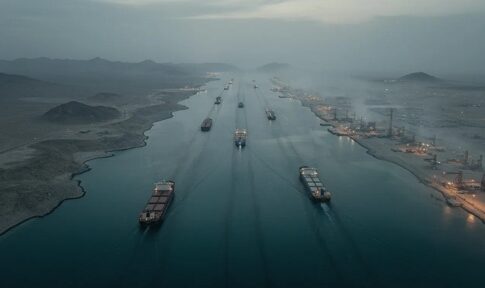
Iran’s Islamic Revolutionary Guard Corps fired missiles at commercial ships in the Strait of Hormuz — a waterway that carries roughly a quarter of the world’s oil — and warned every vessel in the area: “This is the last warning. You are all in danger.”
Story Snapshot
- Iran’s Revolutionary Guard fired missiles at commercial ships in the Strait of Hormuz, damaging at least two vessels with no casualties reported.
- The Guard declared the strait closed on March 2, 2026, after U.S. and Israeli strikes on Iran — and later redefined it as a vast military “operational area.”
- More than 1,500 ships from 87 countries are stranded in the Gulf, according to U.S. Central Command.
- The United Nations Security Council rejected Iran’s closure as a serious threat to international peace, while President Trump announced a U.S. naval blockade in response.
Missiles in the Strait — What Happened
Iran’s Islamic Revolutionary Guard Corps (IRGC) fired at least two missiles at commercial ships near the Strait of Hormuz, hitting two vessels and causing significant damage. No casualties were reported. The UK Maritime Trade Operations agency confirmed a tanker was struck by a projectile, causing a fire. The attacks came after a brief ceasefire expired, and audio from Iranian naval forces broadcast a direct threat to all ships in the area.
The IRGC officially declared the strait closed on March 2, 2026, following U.S. and Israeli air strikes on Iran. By March 4, the Guard claimed full control of the waterway, with at least eight vessels damaged. A Malta-flagged ship, the Safeen Prestige, was struck and its crew forced to evacuate. A U.S.-flagged vessel was hit twice at the port of Bahrain, sparking a fire.
Iran Rewrites the Rules — and Charges a Toll
In May 2026, the IRGC announced it had redefined the Strait of Hormuz as a “vast operational area,” stretching from the Iranian port city of Jask all the way to Siri Island. Iran released a map showing its claimed zone extending into United Arab Emirates territorial waters, leaving no space for international waters. Ships were told they could only pass with permission and on routes set by Iranian armed forces.
Iran also began charging ships up to $2 million to pass through the strait. Legal experts say this violates international maritime law, specifically the United Nations Convention on the Law of the Sea (UNCLOS), which bans fees for the right of passage. The UN Security Council rejected Iran’s closure outright, calling it a serious threat to international peace and security. Iran pushed back, saying it was only blocking ships linked to the U.S., Israel, or their allies.
Trump Fires Back — and the Stakes Rise for Everyone
President Trump responded by announcing a U.S. naval blockade of the strait. On day one, U.S. Central Command reported that no ships passed through and six merchant vessels were turned away. Trump warned Iran bluntly, saying the U.S. could “knock down their bridges in one hour” and that the choice was simple: “We’re either going to make a deal or we’re going to finish the job.”
Three commercial ships were hit by projectiles in the Strait of Hormuz, UKMTO said, as Qatar blamed Iran, raising fresh concerns over maritime security and global energy supplies.#StraitOfHormuz #UKMTO #Qatar #Iran #MaritimeSecurity #WestAsia https://t.co/FByLQv7v5b
— Global Tribune (@GlobalTribuneMN) July 7, 2026
The crisis has real consequences for everyday Americans and people around the world. The Strait of Hormuz carries roughly a quarter of global oil flows. With over 1,500 ships from 87 countries stranded in the Gulf, energy prices are climbing. Iran briefly declared the strait open on April 17, but the IRGC reversed that decision just one day later. The U.S. then seized an Iranian-flagged cargo vessel on April 19. This standoff is far from over — and the cost is being felt at gas pumps and in supply chains across the globe.
A Pattern Decades in the Making
Iran has threatened to close the Strait of Hormuz many times before but never followed through — until now. During the Iran-Iraq War, Iran imposed conditions on ship traffic but kept the strait open. Even during heavy international sanctions, Iran stopped short of a full closure. What’s different in 2026 is that Iran actually acted on its threat, damaged ships, laid sea mines, and demanded payment for passage — steps that cross lines it had never crossed before.
Whether you lean left or right, this situation should concern you. Global energy markets don’t care about political parties. A disrupted strait means higher oil prices, which means higher costs for heating, transportation, and goods. Both sides of the political aisle have long complained that Washington is slow to protect American economic interests. This crisis is a direct test of whether the U.S. government can respond effectively — or whether ordinary citizens will once again pay the price for a conflict between powerful players in Washington and abroad.
Sources:
aljazeera.com, facebook.com, youtube.com